150 years ago was the tragedy of President Abraham Lincoln being murdered. He was shot at Ford’s Theater on Friday April 14th, and he passed away at 7:22am the following day. In the late fall of 2005, I read Lincoln for the Ages, which I think is great, (minus chapter 49)! The day after Christmas, I had to go to work at my “temp” job showing model homes. I was in Brighton, Colorado, sitting in a model home. No one was visiting, so I read in the quiet home, reaching the conclusion of the book. Reading the chapter on the death of Lincoln, once I reached 7:22am on April 15th, I cried. There after a nice Christmas, there in a model home, there in Colorado 140 years after he was killed, I cried, because even though I never even lived in this world at the same time as Lincoln, after reading that book, I love him.
Scripture teaches people are sinful because of the separation between God and man. Doing that which is opposed to the will of God is wrong and brings hurt. There are countless tragedies in history because of sin. There will be tragedies today in this world because of sin. And Scripture teaches Jesus is the only hope for people, the One who offers mercy for any person, and the One who will in His time carry out justice by judging all people. Jesus died as the substitute for the consequence of sins of anyone, which is spiritual death, thus now any person who receives His gift by believing in Jesus will be forgiven of sins and will have eternal life.
The Bible teaches dying for someone is the greatest act of love. Jesus died for people, because He loves people.
When Abraham Lincoln and Mary Todd took their wedding vows, Abraham place a ring on her finger which was inscribed: “Love is eternal.”[1] The teaching of Scripture is that such eternal true love comes from Jesus, the One who loves everyone.
Hunter Irvine
[1] Ralph Newman, ed., Lincoln for the Ages (Garden City, New York: Doubleday and Company, Inc., 1960), 81.

THE FAITH OF ABRAHAM LINCOLN: The Christian conversion testimony of Lincoln is the focus of this blog. Included is a scanned copy from "The Chronicle" from November 3, 1864, which may be the earliest written report of the testimony.
Wednesday, April 15, 2015
Thursday, February 12, 2015
On the birthday of Abraham Lincoln
On this day of remembrance, I explain why I have
an intense interest in the faith of Abraham Lincoln, a subject debated by many folks over the years. When I was a young boy, my family moved to
Northern Virginia because my dad gained a job with the Federal government in
Washington, D.C. As a boy, one summer
day Mom took my sister and I to see the Lincoln Memorial. I was extremely impressed and moved
emotionally as I read his profound words etched in the stone. Afterwards we walked around the side of the
building to an area where there was a window where you could see the open space
under the Lincoln Memorial, which I thought was cool. Nearby was a woman sitting at a portable stand
selling Abraham Lincoln books. Before
leaving we looked at her books, and I found one on my reading level. My mom, who was always supportive of me
reading, offered to buy it for me.
The book was Abraham Lincoln by Anne
Colver, first published in 1960. I read
the book, and the result was that as a young boy, I came to admire Abraham
Lincoln. As I grew older, I gained an increasing
interest in American history, and my admiration for Lincoln only increased. As a Boy Scout with Troop 150 in Annandale,
Virginia, we toured many Civil War battle sites, so many I got tired of the
many war details. Though an active
teenager who was more interested in having fun with my fellow Scouts than the
war stuff, I still gave plenty of attention to the Civil War education, and I
learned the Civil War was an epic tragedy.
I remember standing once in a museum at one of the many battlefields we
toured, reading the statement that more Americans were killed in the Civil War
than any other war. I was saddened.
Less than one year after graduating from the
great Virginia Tech, I gave my heart to Jesus.
Thus I have been following Jesus since that April day in 1990. Years later, I was reading a book which has
short biographies of many Christians, entitled More Than Conquerors.[1] That book has a piece about the faith of
Abraham Lincoln. The piece was fascinating, but the author did not give a single citation. Thus when he gave the testimony of Lincoln, I
had no way of knowing if it was genuine.
The result is I wanted to learn whether the
testimony given was legit. Over three
years later, I was studying at the special Colorado Christian University, and I
had the opportunity to hear Dr. Ronald Rietveld, professor emeritus at
California State University, Fullerton, speak.
His topic: the faith of Abraham Lincoln.
And the pinnacle of the talk was the same testimony told in More Than
Conquerors. Afterwards he told me he
had personally seen the quote written by Lincoln himself in a letter which had
been archived by someone at, or from, New York Avenue Presbyterian Church. After talking with Dr. Rietveld, I began
doing my own research into the testimony, and this blog expresses the results
of that research.
Hunter Irvine
Hunter Irvine

Sunday, January 11, 2015
Abraham Lincoln photogravure from Fassett
The sole purpose of this post is to give information about the photogravure which heads this blog, a blog which considers the Christian testimony of Abraham Lincoln.
Who took the original photo? It was Samuel M. Fassett.
Take a close look at this famous picture by Fassett:
![[Abraham Lincoln, half-length portrait, facing right]](https://cdn.loc.gov/service/pnp/cph/3a10000/3a13000/3a13800/3a13881r.jpg)
Portrait by Samuel M. Fassett from October of 1859.
LC-USZ62-11492
Courtesy of Library of Congress
This portrait is best known to be the one that First Lady Mary Todd Lincoln liked the most!
The Library of Congress has two photos listed together, apparently the same photo, though the second is more of a closeup like the photogravure:
![[Abraham Lincoln, half-length portrait, facing right]](https://cdn.loc.gov/service/pnp/cph/3a10000/3a10000/3a10300/3a10368r.jpg)
Portrait by Samuel M. Fassett from October of 1859.
LC-USZ62-7727
Courtesy of Library of Congress
My discovery of the photogravure all started with a tour in East High School in Denver. (I tell that story at the end of this piece.) That led to an Internet search where I found a 1907 pamphlet advertising the sale of the photogravure by A.W. Elson and Co.
You can check it out at the "Open Library:"
A.W. Elson and Company had copyrighted the photogravure in 1894, and they clearly identified Alexander Hesler as the photographer in their advertisement. They also claimed it came from a daguerreotype.
I assumed the pamphlet was true until one day I was in a bookstore looking at a Lincoln book. I saw this photo in that book, and I recognized it! Hesler was not identified as the photographer, thus I started researching the subject.
Did A.W. Elson make a mistake regarding the photographer? Yes.
And they may have made a mistake saying it came from a daguerreotype. I read information from the Smithsonian Institute, on a web-page which is now gone, and that person said the picture is a Salt Print.
And it is widely stated the "negative" was destroyed in the Chicago fire in 1871. If so, A.W. Elson and Co. would have made the photogravure simply from a print, though they claimed to have a daguerreotype. There remains a bit of a mystery for me on this subject.
In-spite of their big mistake about the identify of the photographer, and in-spite of a possible mistake about their source for their photogravure, I personally am grateful that A.W. Elson and Co. of Boston produced such a magnificent photogravure!
Offering an addition in 2025, I found two photos on the Internet which are a treasures, because they have Fassett's studio mark on the back of the photo.
The source: "Scholars Junction" at Mississippi State University.
Here is the front and the back!!


Fassett Portrait of Lincoln,
Frank and Virginia Williams Collection of Lincolniana,
Mississippi State University Libraries.
I first viewed this great portrait during a tour of East High School in Denver, Colorado, as a part of "Doors Open Denver," in 2013. I was going from the museum room to the observation tower. (East High is quite the exquisite high school. How many high schools have a museum room?) This portrait hung on the wall by the stairwell leading to the tower. (Recognizing it's value, I talked with an administrator at East High the next day to recommend it come under better security surveillance.)
I found the large portrait to be stunning. I stood there for awhile admiring it. I wished I had a camera.
The portrait was a gift from five African-American graduates of East High School, called Denver High School at that time, in appreciation of all Lincoln did for African-Americans. The gift was given on Lincoln's birthday in 1897. I was touched by their gratitude, and I was encouraged by their genuine appreciation for the work and the sacrifice which Abraham Lincoln made for his fellow American citizens.
I am proud to have that photogravure heading this blog. The day I saw this magnificent portrait for the first time was a great day in my life, since it was a personal view of the man who served for the cause of morality, with hope for goodness for all people.
Hunter Irvine
(This piece was edited on 9/6/2025.)
Saturday, December 6, 2014
Americans mourned, and we all can keep learning.
I edit this piece here on 2/18/19, since Isaac E. Carey moves from the forefront now that I have read The Chronicle from November 3, 1864. That is obviously where Reverend Carey got the testimony for his sermon, and that document becomes much more important. Yet I did not want to delete this piece since the description of Americans mourning the death of Lincoln is important. And thanks to Reverend Carey's sermon, I had encouragement to keep searching over a period of ten years for further evidence of the testimony!
Note my presentation of historical evidence does not mean I am advocating all of the theologies expressed. I have serious disagreements with some things Reverend Carey said at other times in this sermon from June 1, 1865, which was given over a half year after the sermon where he told of the conversion testimony. Yet we can learn from certain folks in history even if we have disagreements. And we can all continue learning more from God through His revelations given in Scripture.
Note my presentation of historical evidence does not mean I am advocating all of the theologies expressed. I have serious disagreements with some things Reverend Carey said at other times in this sermon from June 1, 1865, which was given over a half year after the sermon where he told of the conversion testimony. Yet we can learn from certain folks in history even if we have disagreements. And we can all continue learning more from God through His revelations given in Scripture.
Here are two sentences from Reverend Carey: “The mourning was not simply formal, but sincere and deep. It
was not confined to the great cities, where many thousands could gather to
witness the imposing obsequies and look upon the remains of the deceased President,
but extending throughout the land, and manifesting itself in a very marked way
at all the villages and stations through which the funeral cortege passed in
its long course to the place of burial; people of every place along the route, gathering
at the stations, in great numbers and by means of bonfires, the tolling of bells,
the singing of dirges, the scattering of flowers in the Funeral Car, and other appropriate
acts, expressing their love and reverence for the departed good man and Savior
of his country, and their deep sorrow in view of his untimely death.”[1]
And I repeat from the previous post Lincoln’s key quote in response to an African-American man calling him the “great Messiah,” as written by Carl Sandburg: “Don’t kneel to me.
You must kneel to God only and thank him for your freedom.”[2]
Hunter Irvine
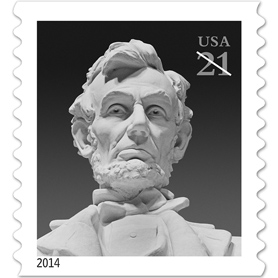
United States Postal Service stamp issued on February 12, 2014.
Carol Highsmith took the original photograph, and Derry Noyes was the Art Director for the 21 cent stamp.
United States Postal Service stamp issued on February 12, 2014.
Carol Highsmith took the original photograph, and Derry Noyes was the Art Director for the 21 cent stamp.
[1] Isaac E. Carey, “Abraham
Lincoln. The Value to the Nation of his Exalted Character,” sermon preached on June
1, 1865, at the First Presbyterian Church of Freeport, Illinois,
[2] Carl Sandburg, Abraham
Lincoln: The Prairie Years and The War Years One-Volume Edition (New York:
Harcourt, Inc., 1954), 684.
Lincoln said, "Don't kneel to me..."
In examining the faith of Abraham Lincoln, we learn he recognized he was
not the Savior of the African-Americans, and we learn he himself knew
the Savior. I preface this claim by saying some attribute
the popularity of Lincoln in the wake of his death by wrongfully claiming he
was killed on Good Friday, yet this is not accurate because Lincoln was shot on
Good Friday, in the evening, yet Lincoln did not pass away until Saturday,
April 15, 1865, at 7:22 am. (1) Then the
following morning was Easter, April 16, 1865.
Since he did not die on Good Friday, the American Messiah analogy loses
its evidence. It is true that once
Lincoln was shot, he never regained consciousness. (2)
Lincoln would have shunned people making him some sort of American Messiah. Going back less than two weeks from his physical death to April 3, 1865, Lincoln entered Richmond after it was gained by the Union troops. In my opinion, going to Richmond was one of the worst decisions Lincoln ever made. It made him look like a conqueror, and it surely increased bitterness against him there in the weeks preceding his assassination. Now I do not think this was his intention at all. Lincoln liked to be actively involved; his daily schedule was intense. And I personally think Lincoln saw his visit to Richmond as his way of supporting the country, rather than coming as a conqueror. Yet my objective here is not to get into that history, rather I will simply say that reading about the journey into Richmond by Lincoln is one of the most surreal and incredible events I have read concerning American history. And from the event is preserved his priceless statement about the Messiah. Here is what Carl Sandberg said the response of Lincoln was after an African-American man called Lincoln the "great Messiah," fell on his knees, and then bowed at the President's feet: "Don’t kneel to me. You must kneel to God only and thank him for your freedom.” (3)
Secondly, regarding his knowledge of the Savior, we learn the Savior is the reason he wanted to visit the Holy Land. I close with what Reverend Miner said, which Johnson got from the Lincoln Scrapbook of the Library of Congress: “Mrs. Lincoln informed me that the last day he lived was the happiest of his life. The very last moments of his conscious life were spent in conversation with her about his future plans, and what he wanted to do when his term of office expired. He said he wanted to visit the Holy Land and see those places hallowed by the footprints of the Saviour. He was saying there was no city he so much desired to see as Jerusalem…” (4)
Hunter Irvine
(1) Ralph G. Newman, ed., Lincoln for the Ages (Garden City, New York: Doubleday and Company, Inc., 1960), 404.
(2) Ralph G. Newman, ed., Lincoln for the Ages (Garden City, New York: Doubleday and Company, Inc., 1960), 404.
Lincoln would have shunned people making him some sort of American Messiah. Going back less than two weeks from his physical death to April 3, 1865, Lincoln entered Richmond after it was gained by the Union troops. In my opinion, going to Richmond was one of the worst decisions Lincoln ever made. It made him look like a conqueror, and it surely increased bitterness against him there in the weeks preceding his assassination. Now I do not think this was his intention at all. Lincoln liked to be actively involved; his daily schedule was intense. And I personally think Lincoln saw his visit to Richmond as his way of supporting the country, rather than coming as a conqueror. Yet my objective here is not to get into that history, rather I will simply say that reading about the journey into Richmond by Lincoln is one of the most surreal and incredible events I have read concerning American history. And from the event is preserved his priceless statement about the Messiah. Here is what Carl Sandberg said the response of Lincoln was after an African-American man called Lincoln the "great Messiah," fell on his knees, and then bowed at the President's feet: "Don’t kneel to me. You must kneel to God only and thank him for your freedom.” (3)
Secondly, regarding his knowledge of the Savior, we learn the Savior is the reason he wanted to visit the Holy Land. I close with what Reverend Miner said, which Johnson got from the Lincoln Scrapbook of the Library of Congress: “Mrs. Lincoln informed me that the last day he lived was the happiest of his life. The very last moments of his conscious life were spent in conversation with her about his future plans, and what he wanted to do when his term of office expired. He said he wanted to visit the Holy Land and see those places hallowed by the footprints of the Saviour. He was saying there was no city he so much desired to see as Jerusalem…” (4)
Hunter Irvine
(1) Ralph G. Newman, ed., Lincoln for the Ages (Garden City, New York: Doubleday and Company, Inc., 1960), 404.
(2) Ralph G. Newman, ed., Lincoln for the Ages (Garden City, New York: Doubleday and Company, Inc., 1960), 404.
(3) Carl Sandburg, Abraham Lincoln:
The Prairie Years and The War Years One- Volume Edition (New York:
Harcourt, Inc., 1954), 684.
(4) William J. Johnson, Abraham
Lincoln the Christian (New York: Eaton and Mains, 1913), 182.
Saturday, November 29, 2014
The immorality of slavery
Once I was talking with a student in the CCU library about Abraham
Lincoln with much enthusiasm. The
student then asked why I admired Lincoln so much. My response paraphrased: Lincoln was a
brilliant and logical thinker, unique, had a passion for living, and was a caring man. On the other hand Lincoln made a few big
mistakes and plenty of little ones. Like
the rest of us, Lincoln was human. Yet
the foundational reason why Lincoln is a hero for me is that through the
brilliance and mistakes, Abraham Lincoln remained convicted that slavery is
morally wrong.
Many students find this statement to be mundane, since most people of the college age generation in the U.S. today think slavery is immoral. Yet the courage of Lincoln becomes more evident when we learn how many people in the U.S. culture advocated the morality of slavery during the time of Lincoln. To give some context, I give a miniscule overview, not promoting corporate judgment on this occasion on specific individuals in history. Slavery has been a sin practiced in many places of the world at various times since ancient times; read Hammurabi’s Code for example. The institution continued upon the foundation of the United States in the last quarter of the 1700’s, and both George Washington and Thomas Jefferson owned slaves. To be personal, the more I researched this subject, the more extensive I found the horror to be. It was an American tragedy.
For those who know me, you know I love the United States of America! And I think the Declaration of Independence and the Constitution are blessed governmental documents in world history. Yet the big mistake in the Constitution originally was in Article I; Section 2, was a distinction was made between residents who were “free” and residents who were not “free.” This section alone, where those who were not “free” were accorded three-fifths status for purposes of representation and direct taxation, allowed states to determine whether slavery was legal. The result was that some states carried on with the legal protection of slavery, action which was in complete contradiction with the Declaration of Independence which stated “all men are created equal.”
Slavery was so entrenched in the U.S. the three largest Christian denominations, the Baptist Missionary Convention, the Presbyterian, and the Methodist-Episcopal denominations split before the Civil War, in 1845, 1837, and 1843 & 1844 respectively. Another denomination, the Episcopal denomination, split at the time of the war. I recommend reading the details on this, which I consider a precursor to the Civil War, in "Broken Churches, Broken Nation," written by the editors of Christian History in Issue 33 (Vol.XI, No.1) 26-27. There was a divisive dispute over what the Bible teaches concerning the issue of slavery. Some said the Bible prohibits slavery; some said the Bible permits slavery. The result was a tragedy within the Christian family, and contradictory messages were sent to the culture at large by those called to be a light for Christ to the culture. The long term result was a mammoth corporate tragedy in U.S. history, the Civil War.
The focus of this blog is the faith of Abraham Lincoln, and ultimately that faith was possible because of the glorious work of Jesus on the Cross, and the steadfast love by God for Abraham Lincoln in reaching out to him even before he was in relationship with Jesus, just as God does for all people. Yet what does Lincoln’s conviction concerning slavery have to do with his faith? The Bible reveals that God calls His children to love people by obeying the commands of Jesus as clearly taught in John 14:21. Thus faith in Jesus is in harmony with moral behavior, which ultimately results in loving behavior.
Regarding his moral conviction that slavery is wrong, on one hand, Lincoln once stated he had always felt slavery was wrong, stating he could not recall a time when he believed otherwise.[1] He even referred to it as an “abstract judgment.”[2] In using such a term, it is possible that a diplomatic mode of Lincoln was exhibited here, as was often exhibited, where he would present diplomatic discourse. Yet he would still retain a logical argument and a pounding conclusion. On the other hand, in a letter, Lincoln also presented a specific basis for his moral judgment. Whether or not the “Golden Rule” taught by Jesus as recorded in Matthew 7:12 was an influence, we cannot know, yet it is possible.
Abraham Lincoln wrote to a man: “…he who would be no slave, must consent to have no slave. Those who deny freedom to others, deserve it not for themselves; and, under a just God, cannot long retain it.”[3] Brilliant. God came into his dialogue more and more, to the point of his famous second inaugural address.
Though sometimes wavering in arguments of how to deal with slavery, Lincoln always remained steadfast in his conviction that slavery is wrong. Lincoln understood doing wrong brings trouble to people, and can even bring trouble to a country as a whole. Abraham Lincoln increased in his advocation for doing what is right, right as is determined by God.
Hunter Irvine
Many students find this statement to be mundane, since most people of the college age generation in the U.S. today think slavery is immoral. Yet the courage of Lincoln becomes more evident when we learn how many people in the U.S. culture advocated the morality of slavery during the time of Lincoln. To give some context, I give a miniscule overview, not promoting corporate judgment on this occasion on specific individuals in history. Slavery has been a sin practiced in many places of the world at various times since ancient times; read Hammurabi’s Code for example. The institution continued upon the foundation of the United States in the last quarter of the 1700’s, and both George Washington and Thomas Jefferson owned slaves. To be personal, the more I researched this subject, the more extensive I found the horror to be. It was an American tragedy.
For those who know me, you know I love the United States of America! And I think the Declaration of Independence and the Constitution are blessed governmental documents in world history. Yet the big mistake in the Constitution originally was in Article I; Section 2, was a distinction was made between residents who were “free” and residents who were not “free.” This section alone, where those who were not “free” were accorded three-fifths status for purposes of representation and direct taxation, allowed states to determine whether slavery was legal. The result was that some states carried on with the legal protection of slavery, action which was in complete contradiction with the Declaration of Independence which stated “all men are created equal.”
Slavery was so entrenched in the U.S. the three largest Christian denominations, the Baptist Missionary Convention, the Presbyterian, and the Methodist-Episcopal denominations split before the Civil War, in 1845, 1837, and 1843 & 1844 respectively. Another denomination, the Episcopal denomination, split at the time of the war. I recommend reading the details on this, which I consider a precursor to the Civil War, in "Broken Churches, Broken Nation," written by the editors of Christian History in Issue 33 (Vol.XI, No.1) 26-27. There was a divisive dispute over what the Bible teaches concerning the issue of slavery. Some said the Bible prohibits slavery; some said the Bible permits slavery. The result was a tragedy within the Christian family, and contradictory messages were sent to the culture at large by those called to be a light for Christ to the culture. The long term result was a mammoth corporate tragedy in U.S. history, the Civil War.
The focus of this blog is the faith of Abraham Lincoln, and ultimately that faith was possible because of the glorious work of Jesus on the Cross, and the steadfast love by God for Abraham Lincoln in reaching out to him even before he was in relationship with Jesus, just as God does for all people. Yet what does Lincoln’s conviction concerning slavery have to do with his faith? The Bible reveals that God calls His children to love people by obeying the commands of Jesus as clearly taught in John 14:21. Thus faith in Jesus is in harmony with moral behavior, which ultimately results in loving behavior.
Regarding his moral conviction that slavery is wrong, on one hand, Lincoln once stated he had always felt slavery was wrong, stating he could not recall a time when he believed otherwise.[1] He even referred to it as an “abstract judgment.”[2] In using such a term, it is possible that a diplomatic mode of Lincoln was exhibited here, as was often exhibited, where he would present diplomatic discourse. Yet he would still retain a logical argument and a pounding conclusion. On the other hand, in a letter, Lincoln also presented a specific basis for his moral judgment. Whether or not the “Golden Rule” taught by Jesus as recorded in Matthew 7:12 was an influence, we cannot know, yet it is possible.
Abraham Lincoln wrote to a man: “…he who would be no slave, must consent to have no slave. Those who deny freedom to others, deserve it not for themselves; and, under a just God, cannot long retain it.”[3] Brilliant. God came into his dialogue more and more, to the point of his famous second inaugural address.
Though sometimes wavering in arguments of how to deal with slavery, Lincoln always remained steadfast in his conviction that slavery is wrong. Lincoln understood doing wrong brings trouble to people, and can even bring trouble to a country as a whole. Abraham Lincoln increased in his advocation for doing what is right, right as is determined by God.
Hunter Irvine
[1] Albert Bushnell Hart, ed.,
Selected Writings of Abraham Lincoln (New York: The Gregg Publishing
Company, 1920), 299.
[2] Albert Bushnell Hart, ed.,
Selected Writings of Abraham Lincoln (New York: The Gregg Publishing
Company, 1920), 300.
[3] Ralph G. Newman, ed., Lincoln
For the Ages (Garden City, New York: Doubleday and Company, Inc., 1960), 279-280.
Wednesday, November 26, 2014
Dr. Ronald Rietveld and the primary source
As incredible as the 1864 sermon by Isaac E. Carey is, it is not a primary source. The person who talked with Lincoln is not even named. Yet there is a primary source. I have not read it, yet I know someone who has: Dr. Ronald Rietveld, Professor Emeritus of History, and full time professor for forty years at California State University, Fullerton. Dr. Ron Rietveld is a honored Lincoln scholar.
On February 16, 2009, Dr. Rietveld spoke at Colorado Christian University on the faith of Abraham Lincoln. It was one of the best talks I have ever heard. His thesis was that the faith in God by Abraham Lincoln was a long growth process involving seeking, with valleys and peaks over time, which then culminated in a commitment to Christ. In my four and a half special years at CCU, that night was one highlight, because as a person who has long considered Lincoln a hero, I had an interest in the Christian faith of Abraham Lincoln. And here Dr. Rietveld gave a talk on the subject as if he and Lincoln had been friends for many years. Because of Dr. Rietveld’s talk, I started researching with a passion.
The entire talk captivated me, yet the grand pinnacle of Dr. Rietveld’s talk was the fact he had held in his hands a letter from Abraham Lincoln to a pastor, and I did not catch who that pastor was, where Lincoln gave a statement of Christian conversion similar to the one in Isaac E. Carey’s sermon. Wow.
After his talk, I had the privilege to talk with Dr. Rietveld, though it was a rushed conversation since there were several other people who wanted to talk with him. I asked him where he had read the conversion testimony letter by Lincoln, and he said it had been in an archive maintained by New York Avenue Presbyterian Church in Washington D.C., the church where Lincoln worshiped at the time of his death. Though I did not find it there, as I will go on to explain, my search quickly led to finding the unexpected sermon in the Freeport Weekly Journal of 1864!
Regarding the letter Dr. Rietveld spoke of, after correspondence and conversations with some historians and archivists affiliated with the church, including Wilson Golden, Dan Stokes, and Dr. Elaine Foster, I learned none of the three were aware of the letter even existing, let alone being aware it was in the archives of New York Avenue Presbyterian Church. I add that Dr. Elaine Foster was extremely kind, and she emailed the text of some key Lincoln letters. And though getting the unique opportunity to visit New York Avenue Presbyterian Church for one day after flying to D.C. from Denver in the summer of 2009, there was a death in a family of one of the historians which obviously made it necessary to cancel our meeting. And I ended up not getting to even search through any archived material. My day planned far in advance to view the archived material at that church came up empty, which was disappointing. Yet it was not a total loss, since I did get an extensive private tour of Lincoln’s church which I am thankful for, and I got to sit in his pew which is preserved there. That was super cool.
I have continued to do some research regarding that letter, to no avail. I still have hopes that as more and more information is scanned and made available on the Internet, that this primary source will be found and made available for public viewing.
I note that for a long time in the 20th century, the main reference for the conversion testimony was the clear statement published by Osborn H. Oldroyd in 1882.[1] Considering that he mentioned an Illinois clergyman, his source was probably Isaac Carey, though he did not get the quote completely correct, nor the source. And a book by William Jackson Johnson (whose name on the cover is Johnstone, which is an incorrect spelling of his actual name), in 1913, was also often cited.[2] But Johnson's source is actually Mr. Oldroyd's book, and nothing more. This book was proudly shown to me when I was given a tour of New York Avenue Presbyterian Church. We can be thankful for Osborn Oldroyd's recording of the testimony, because before the Internet, published books were far more effective preservers of history for the masses than periodicals, which have always been a challenge for library storage and retrieval. The digital age has changed that.
I close by saying I totally believe Dr. Ron Rietveld, thus I am convinced the letter exists irregardless of the fact I have yet to see it for myself. I will always be grateful to Dr. Rietveld for his talk at Colorado Christian University. It was a blessing!
[Edited on 2/22/19]
Hunter Irvine

Image is Public Domain from The Lincoln Memorial: Album-Immortelles [3]
On February 16, 2009, Dr. Rietveld spoke at Colorado Christian University on the faith of Abraham Lincoln. It was one of the best talks I have ever heard. His thesis was that the faith in God by Abraham Lincoln was a long growth process involving seeking, with valleys and peaks over time, which then culminated in a commitment to Christ. In my four and a half special years at CCU, that night was one highlight, because as a person who has long considered Lincoln a hero, I had an interest in the Christian faith of Abraham Lincoln. And here Dr. Rietveld gave a talk on the subject as if he and Lincoln had been friends for many years. Because of Dr. Rietveld’s talk, I started researching with a passion.
The entire talk captivated me, yet the grand pinnacle of Dr. Rietveld’s talk was the fact he had held in his hands a letter from Abraham Lincoln to a pastor, and I did not catch who that pastor was, where Lincoln gave a statement of Christian conversion similar to the one in Isaac E. Carey’s sermon. Wow.
After his talk, I had the privilege to talk with Dr. Rietveld, though it was a rushed conversation since there were several other people who wanted to talk with him. I asked him where he had read the conversion testimony letter by Lincoln, and he said it had been in an archive maintained by New York Avenue Presbyterian Church in Washington D.C., the church where Lincoln worshiped at the time of his death. Though I did not find it there, as I will go on to explain, my search quickly led to finding the unexpected sermon in the Freeport Weekly Journal of 1864!
Regarding the letter Dr. Rietveld spoke of, after correspondence and conversations with some historians and archivists affiliated with the church, including Wilson Golden, Dan Stokes, and Dr. Elaine Foster, I learned none of the three were aware of the letter even existing, let alone being aware it was in the archives of New York Avenue Presbyterian Church. I add that Dr. Elaine Foster was extremely kind, and she emailed the text of some key Lincoln letters. And though getting the unique opportunity to visit New York Avenue Presbyterian Church for one day after flying to D.C. from Denver in the summer of 2009, there was a death in a family of one of the historians which obviously made it necessary to cancel our meeting. And I ended up not getting to even search through any archived material. My day planned far in advance to view the archived material at that church came up empty, which was disappointing. Yet it was not a total loss, since I did get an extensive private tour of Lincoln’s church which I am thankful for, and I got to sit in his pew which is preserved there. That was super cool.
I have continued to do some research regarding that letter, to no avail. I still have hopes that as more and more information is scanned and made available on the Internet, that this primary source will be found and made available for public viewing.
I note that for a long time in the 20th century, the main reference for the conversion testimony was the clear statement published by Osborn H. Oldroyd in 1882.[1] Considering that he mentioned an Illinois clergyman, his source was probably Isaac Carey, though he did not get the quote completely correct, nor the source. And a book by William Jackson Johnson (whose name on the cover is Johnstone, which is an incorrect spelling of his actual name), in 1913, was also often cited.[2] But Johnson's source is actually Mr. Oldroyd's book, and nothing more. This book was proudly shown to me when I was given a tour of New York Avenue Presbyterian Church. We can be thankful for Osborn Oldroyd's recording of the testimony, because before the Internet, published books were far more effective preservers of history for the masses than periodicals, which have always been a challenge for library storage and retrieval. The digital age has changed that.
I close by saying I totally believe Dr. Ron Rietveld, thus I am convinced the letter exists irregardless of the fact I have yet to see it for myself. I will always be grateful to Dr. Rietveld for his talk at Colorado Christian University. It was a blessing!
[Edited on 2/22/19]
Hunter Irvine
Image is Public Domain from The Lincoln Memorial: Album-Immortelles [3]
[1] Osborn H. Oldroyd, ed., The
Lincoln Memorial: Album-Immortelles (New York: G.W. Carleton and Co.
Publishers, 1882), 366.
Subscribe to:
Posts (Atom)